Country/Region/City
Each FISU World University Championship is more than just a sporting event — it’s a unique opportunity to discover a new culture, explore a region, and connect with a vibrant academic community.
This page introduces you to the host country and city for this edition, highlighting their history, key features, and commitment to sport and youth.
South Africa
Multi-cultural South Africa, is flanked by the South Atlantic and Indian Oceans, and offers an extreme range of environments from sandy beaches to sub-tropical forests, deserts, and vast expanses of rural landscapes, to vibrant cities and even deserts.
It has 12 official languages, a population of 63 million people, and is one of the oldest inhabited regions globally, with a long and complex history which began a new chapter with Nelson Mandela becoming President after the first fully democratic elections in 1994.
South Africa has three capital cities: Pretoria (administrative), Cape Town (legislative), and Bloemfontein (judicial).
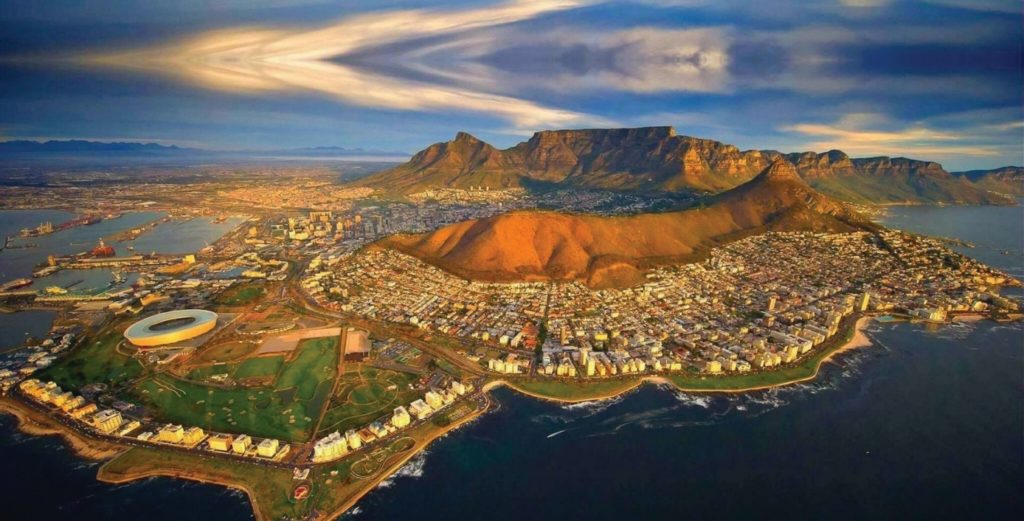
Cape Town & The Fairest Cape global destination
Known as “the Mother City” Cape Town is a mere 50km from Stellenbosch and listed as Best Destination in Africa by the World Tourism Awards.
Located on a peninsula at the tip of Africa where the Atlantic and Indian Oceans meet, it is famed for its natural beauty – the most famous of which is Table Mountain.
From it being home to the San first nation people, through European occupation, a slave station, leper colony, a global Maritime haven and ultimately where Nelson Mandela’s made his first public appearance after decades in prison, it is a cauldron of cultures and the stories of the people past and present who populate the region.
The region, which falls within the Western Cape Province, enjoys a Mediterranean climate (wet mid-year winters and dry year-end summers). September is the start of spring when the indigenous Fynbos plant kingdom comes to life, as well as the vineyards and oak trees that are synonymous with Stellenbosch. It is the ideal time to visit – not too hot with 12.5 hours of daylight and the sun setting around 7pm. The average daytime temperature is 21°C (70°F), dropping to a cosy 12°C (54°F) at night.
Stellenbosch
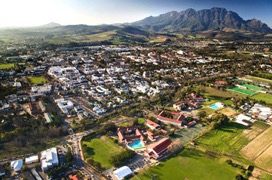
Stellenbosch, is a picturesque 340-year-old university town in the heart of the Cape Winelands just 50 kilometres from central Cape Town. Covering an area of 831 square kilometres that includes vast tracts of rural land and mountain peaks.
The population of greater Stellenbosch is around 156 000 permanent residents – 80 percent are black with close to 20 percent being white. While languages spoken include Afrikaans, English and Xhosa, great efforts continue to be made to celebrate the town’s multi-cultural heritage that includes French Huguenots, Dutch, German and Koi San histories and influences.
Aside from its working wine, brandy and game farms that are open to the public, the area is peppered with historic monuments, art galleries, museums and a selection of wildlife reserves and game parks where visitors can experience giraffe and even lions in a protected habitat.

Stellenbosch University
Stellenbosch University will be involved with this event through its illustrious sporting department, Maties Sport.
Stellenbosch University is one of South Africa’s top research institutions with 41 Research Chairs and 7 Centres of Excellence.
It has 31 000 students enrolled in its 10 Faculties, of which 10 percent are international students.
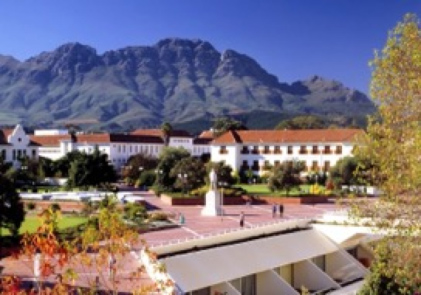
This mainly residential University is spread out in both modern and historic buildings, making Stellenbosch a true University Town.
Its Medical and Military faculties are based at Tygerberg Hospital and in Saldanha Bay, respectively. In addition to academics, the University has 190 registered social impact projects.
Historically, Maties Sport is world-renowned for producing international stars over the past 150 years through its legendary rugby club. Maties Rugby is the largest club of registered players in the southern hemisphere, and has fielded 186 Springboks. However, through continual growth and renewal Maties Sport now provides 3 000+ student-athletes with 30 codes (nine in the high-performance sports arena) and is creating a new legacy of champions in international competition, including the World Students Games, Olympics and Paralympics.
Maties Sport also leads the way through its Recreational and Active Lifestyle Unit (RALU) that encourages all students – especially those who do not participate in traditional sports – towards wellness and to become active through a variety of action programmes and activities.
It is also the seat of the South Africa Centre for Olympic Studies and Social Impact.